Soap Making 101: Quick Start
New to soap making? Start with a simple, safe process and focus on consistency.
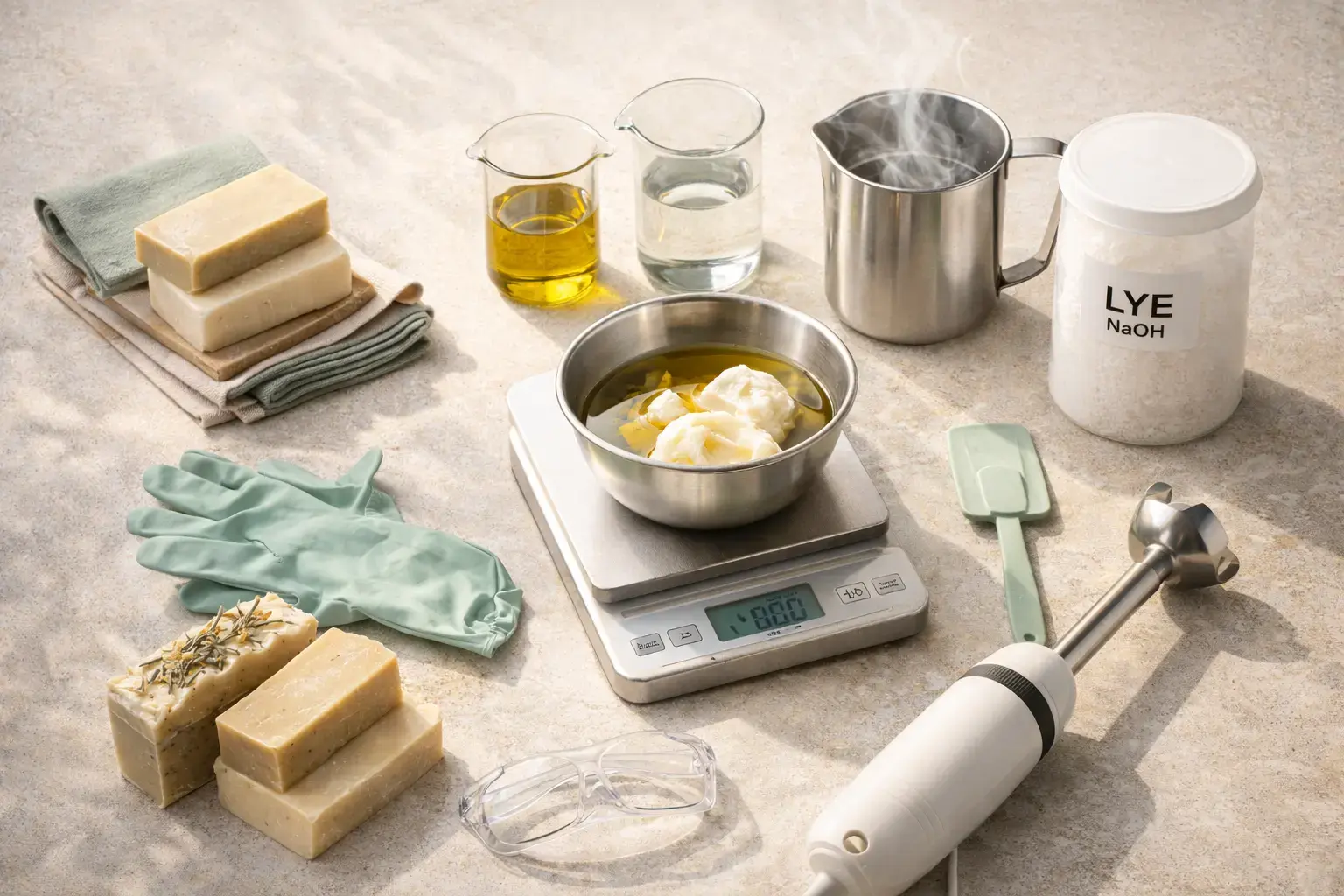
Beginner Soap Making Tutorial
1. Start Safe
Wear splash-proof goggles, chemical-resistant gloves, long sleeves, and closed-toe shoes. Work in a well-ventilated space away from children and pets.
Always add lye to water, never water to lye. Never use aluminum tools or containers because aluminum reacts with lye. Mix slowly to avoid splashing and heat spikes.
2. Gather Beginner-Friendly Materials
- Digital scale (accurate to at least 1 gram).
- Heat-safe containers (stainless steel or HDPE/PP plastic).
- Stick blender, silicone spatula, and soap mold.
- You can also use a whisk to mix, but it will take longer.
- Oils for a simple recipe (for example: olive, coconut, and palm or alternatives).
- Water (distilled is ideal) and sodium hydroxide (NaOH) for bar soap.
3. Build Your Recipe in SudScale
Open the recipe calculator and choose:
- Process type: Cold Process (best for most beginners).
- Lye type: NaOH (Sodium Hydroxide).
- Oil percentages totaling 100%.
- Superfat: around 5% as a common starting point.
- Lye concentration or water:lye ratio within recommended ranges.
In the calculation quality metrics, an INS value around 160 is a common target. A range of about 135-170 is generally good. This is a rule of thumb, and a higher INS usually means a harder, more cleansing (possibly more drying) bar.
Simple starter recipe
- Coconut Oil 30%
- Olive Oil 70%
Review safety warnings before making anything. If a warning appears, adjust inputs first.
4. Mix and Reach Trace
- Measure oils by weight and melt hard oils if needed.
- Prepare lye solution by slowly adding lye to distilled water.
- Let oils and lye solution cool to a safe, similar temperature range (around 100°F / 38°C).
- Combine and stick-blend in short pulses until light trace.
- Add fragrance or additives only if your recipe and safety limits support them.
5. Pour, Insulate, and Cure
Pour into the mold, tap out air bubbles, and let the batch set. Unmold and cut after it firms up (often around 24-48 hours, recipe dependent). Cure bars in a ventilated area for about 4-6 weeks so excess water can evaporate and the bar hardens.
Insulating the mold is optional. Some makers insulate to encourage gel phase, which can give bars a more uniform look and slightly deeper color. If you insulate, keep an eye on heat buildup. Overheating can cause cracking, tunneling, or liquid separation in the center of the loaf.
6. Save and Improve Your Next Batch
Save the recipe and notes in SudScale so you can repeat or adjust with confidence. Track what worked (hardness, lather, scent, unmolding time) and change only one major variable per batch.
This guide is educational only. You are responsible for safe handling and process validation for your environment and ingredients.